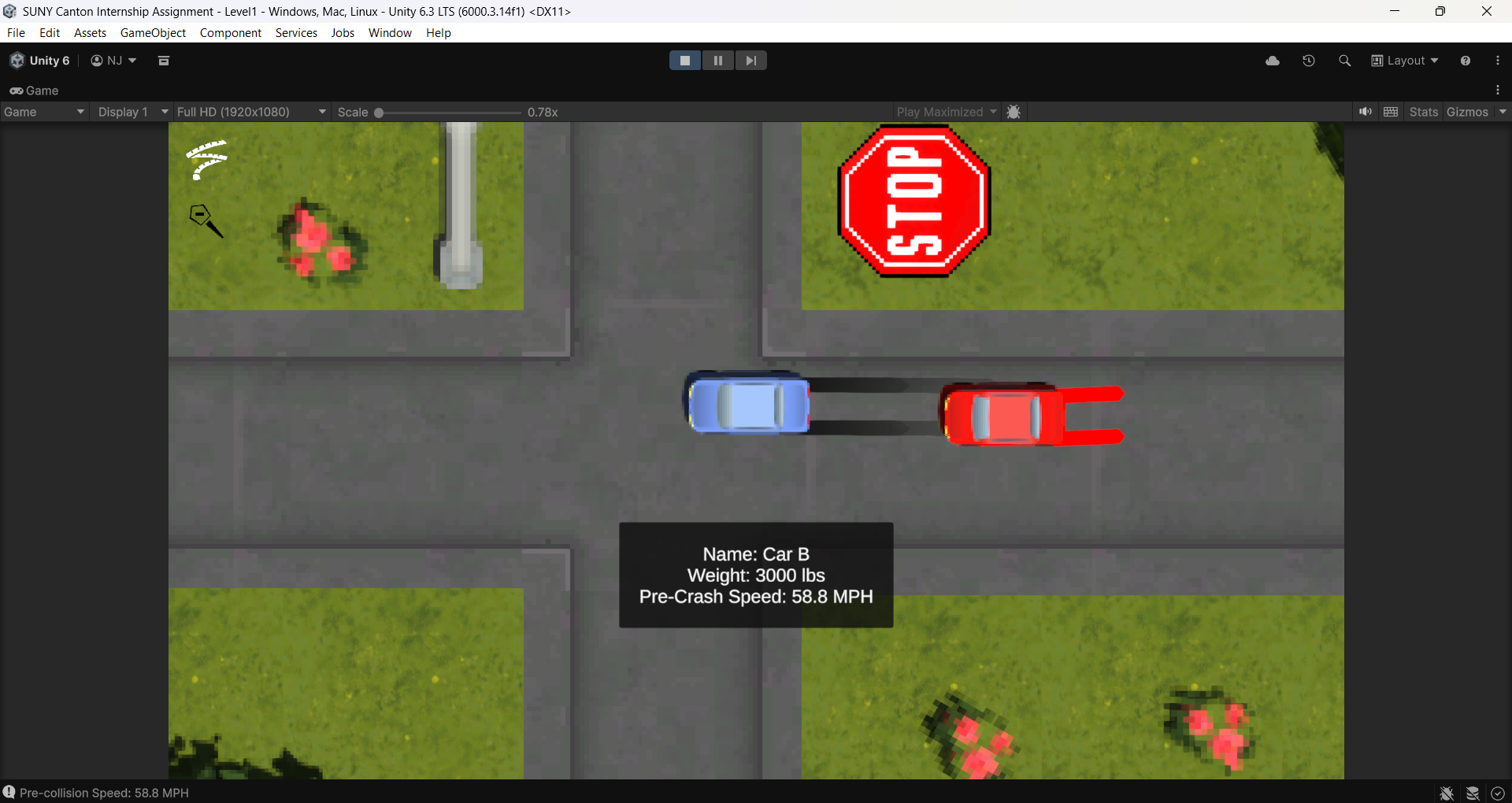
Game development applied to education.
During a game design internship, I worked with faculty in the physics department to create accessible, physics-based educational experiences that can be used to help engage students in learning physics. The work involved turning real-world concepts into interactive simulations that could be understood through interactive play.
Making physical concepts playable.
One area of work involved vehicle-crash simulations and physics-based interactions. Unity's physics systems became a practical design tool rather than simply a technical feature.
Another area involved creating tools and using real-world physics calculations to help students gather relevant data and arrive at an answer, which would be submitted as a passing or failing result before moving on.
Prototype, test, revise.
The internship strengthened my ability to work from a real design problem, build a prototype, receive feedback from faculty and future internship elegable students, and iterate toward something accessible, useful, fun.